KRMOLD plastic chair injection molds can produce traditional and customized chair styles for a wide range of indoor and outdoor applications.
In the manufacturing process of plastic chair injection mould, KRMOLD pays close attention to the cycle time, parting line, wall thickness, and venting.
KRMOLD offers a diverse range of refrigerator parts injection mould capable of producing components such as drawers, egg trays, door liners, handles, door frames, and fridge lower vent frames, fully covering the molding needs for both interior and exterior plastic parts.
KRMOLD is dedicated to providing a complete range of plastic pallet injection molds, capable of producing pallets in various sizes for widespread use in everyday goods handling and product transportation in factories. KRMOLD plastic pallet injection mould not only meet market demands but also offer customized designs based on different customer application scenarios and handling conditions.
KRMOLD specializes in providing high-quality waste bin injection molds, capable of designing and manufacturing plastic trash bin injection molds for various capacities to meet specific project needs, including 32L, 45L, 60L, 80L, 120L, and 240L.
KRMODL can provide customers with a wide range of Logistic Packaging Injection Mold, according to the customer's product requirements for customized design of injection molds and the process of manufacturing injection molds, Logistic Packaging Injection Molds are used for the production of logistics and transportation required for the products. Logistic Packaging Injection Mold is a large-scale injection mold product.
KRMOLD is a professional injection mold manufacturer in China that can provide Food Packaging Injection Molds, which are designed to produce food packaging products with various specific shapes and functions. As an important injection molding tool, Food Packaging Injection Molds can produce food packaging products that meet food requirements. Welcome to contact us to get the latest design solutions
KRMOLD can provide customers with complete Thin-Wall Container Injection Molds solutions to manufacture injection molds that meet the production requirements of thin-walled products, such as disposable lunch box injection molds, electronic component packaging injection molds, and medical device injection molds.
KRMOLD thin wall container injection molds are characterized by high strength mold structure, precise process control and material innovation. Contact us for new injection molding solutions.
KRMOLD helps customers with complete injection mold design, production and after-sales services, and is able to provide customers with Cosmetic Container Injection Molds, which are used to produce molds for various cosmetic packaging containers. Injection molding technology is used to make plastic raw materials into specific shapes of packaging, such as bottles, jars, lids and so on.
What is the Strongest Plastic for Plastic Battery Case Mould?
2026-06-01
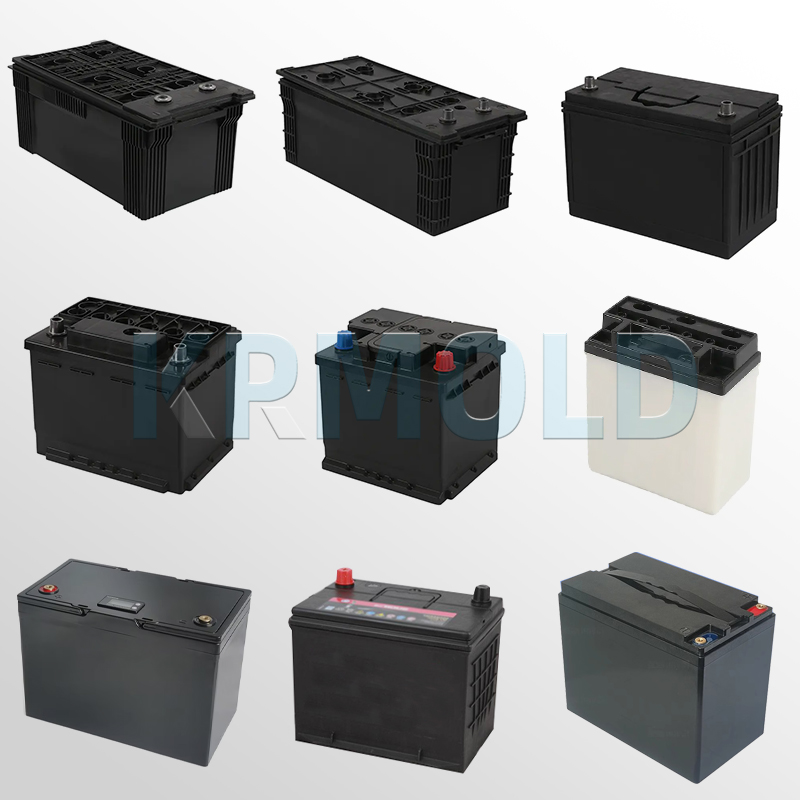
Plastic battery casings, with their advantages of lightweight design, excellent insulation, and ease of molding complex structures, have become core packaging components for power batteries and starter batteries. However, in the mass production processing of plastic battery case mould, most customers face numerous common challenges, including defects such as injection molding warping, shrinkage, fiber floating, and scorching, directly increasing the defect rate of mass production.
Based on these mass production pain points, many manufacturers are exploring the strongest plastic material suitable for car battery box injection mould, hoping to solve all production and usage problems with a single material. However, in reality, there is no absolutely universally applicable strongest plastic. The key to producing high-quality, highly stable plastic battery cases lies not in blindly selecting high-performance plastics, but in achieving a golden match between the plastic material and the car battery box injection mould.
Only by customizing corresponding plastic battery case mould design and manufacturing solutions based on material characteristics can molding defects be completely avoided, ensuring the performance of the battery case and the mass production pass rate.
This article by KRMOLD will provide a detailed analysis of the performance of specialized plastic materials suitable for plastic battery case mould, the differences between mainstream materials, and share customized design and mass production solutions for high-strength car battery box injection mould.
Core Performance Requirements for Plastics Suitable for Plastic Battery Case Mould
1
Excellent Mechanical Strength
Car battery box s need to withstand the vibrations, bumps, and impacts from vehicles during long-term operation. Therefore, the material must possess excellent impact resistance, deformation resistance, and tensile strength to prevent cracking and denting, ensuring the stability of the battery module structure.
2
High Temperature Resistance
Automotive batteries generate a large amount of heat during continuous charging and discharging, with internal temperatures maintained at 80-120℃ for extended periods. Under fault conditions, the temperature can rise sharply. Plastics suitable for plastic battery case mould must possess high heat resistance, remaining unsoftened, undeformed, and undecomposed under high-temperature environments.
3
Good Chemical Resistance
The electrolyte and acidic media inside automotive batteries are highly corrosive, and prolonged contact can easily erode the inner wall of the casing. Qualified battery casing plastics must be resistant to electrolytes and acid/alkali corrosion to prevent aging, cracking, and leakage after long-term use.
4
Injection Molding Compatibility
Car battery boxes are often thin-walled, irregularly shaped, and complex structures with mounting holes. Plastics suitable for mass production molds must have stable flowability, controllable molding shrinkage, and be compatible with high-speed injection molding production of car battery box injection mould.
2. Comparison of Mainstream High-Strength Plastics Suitable for Plastic Battery Case Mould
2.1 PPS – Preferred Material for High-End Power Battery Casings
PPS is a core high-strength material suitable for high-temperature, heavy-load, and high-safety-standard car battery box injection mould, and is also a mainstream material for new energy vehicle power battery casings. Its core advantages lie in its extreme chemical corrosion resistance, which can withstand long-term corrosion from battery electrolytes and acid/alkali media, and has excellent anti-aging performance; its heat resistance temperature reaches up to 260℃, which can easily cope with continuous high temperatures and sudden thermal runaway conditions of batteries; its structural dimensions have zero deviation at high temperatures, and its dimensional stability is extremely strong. Meanwhile, modified PPS can easily achieve the UL94 V-0 flame retardant rating without the need for additional flame retardants, ensuring stable safety performance.
This material is primarily suitable for mass production of plastic battery case mould for new energy vehicle power batteries and high-end industrial high-temperature energy storage batteries. However, PPS is often modified with high glass fiber to enhance strength. The high hardness of glass fiber causes significant wear on the mold cavity of the plastic automotive battery casing, therefore, ordinary steel cannot be used for the car battery box injection mould.
Furthermore, high-temperature injection molding processes are prone to problems such as poor venting, fiber floating, and scorching, placing extremely high demands on the design of the plastic battery case mould’ venting, injection, and cooling systems.
2. PP – An Economical General-Purpose Material for Automotive Battery Casings
PP is a commonly used standard material for car battery box injection mould for traditional automotive starting batteries and low-cost energy storage batteries. Its high cost-effectiveness and ease of processing have made it a mainstream material in the civilian battery casing market. Its core advantages are excellent resistance to acid and electrolyte corrosion, making it perfectly compatible with the dielectric environment of ordinary automotive batteries. It also has good impact resistance and toughness, is not easily brittle under low-temperature conditions, and has low injection molding costs.
However, PP material has significant performance shortcomings: insufficient rigidity, weak resistance to deformation, easy softening at high temperatures, and a high injection molding shrinkage rate. This easily leads to defects such as shrinkage, warping, and deformation in products molded from plastic automotive battery casings, resulting in poor dimensional accuracy. It is unsuitable for the high-precision, high-load production scenarios of power battery casings and is only suitable for mass production of low- to mid-range conventional battery casings. Regarding plastic battery case mould adaptation, the cooling system and pressure-holding injection molding process of car battery box injection mould need to be specifically optimized to offset the defects of material shrinkage and deformation.
Core Design and Manufacturing Solution of KRMOLD High-Strength Plastic Battery Case Mould
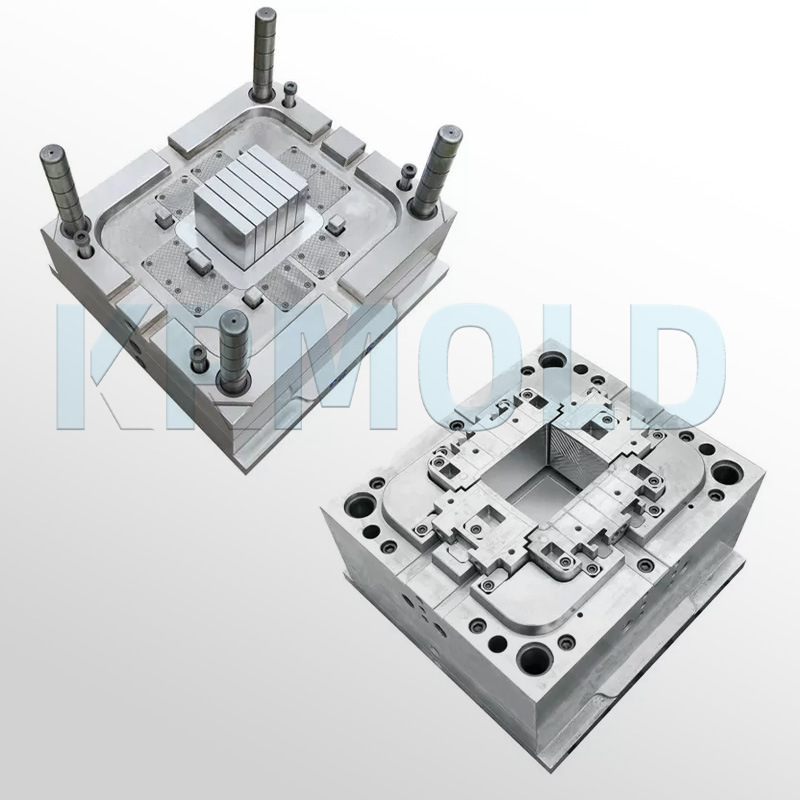
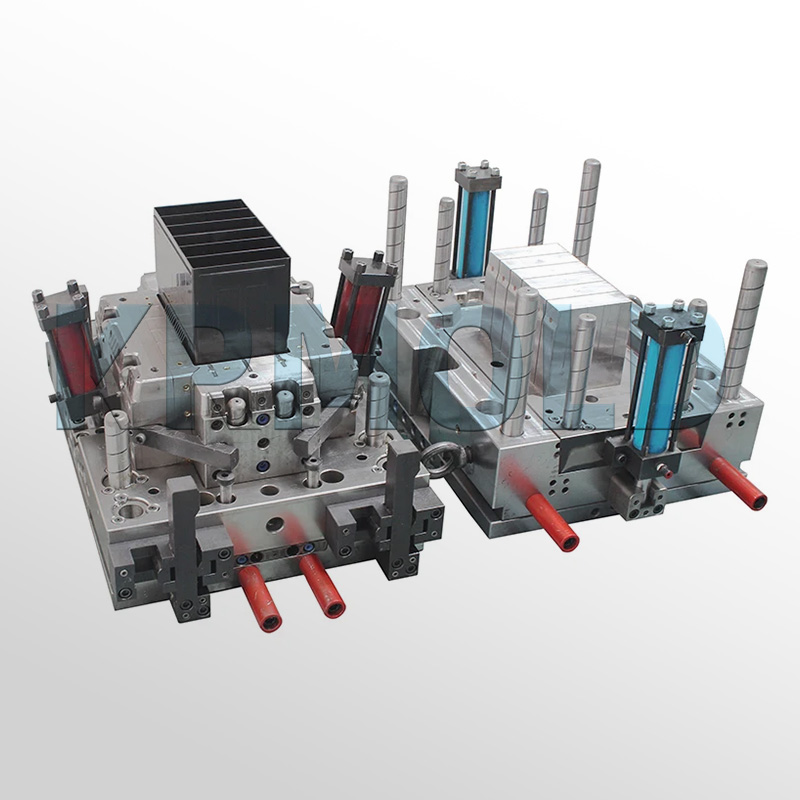
KRMOLD has been deeply involved in the R&D and manufacturing of car battery box injection mould for many years. For different battery casing-specific plastics such as PPS and PP, it has developed a complete set of customized mold design and mass production solutions to achieve precise matching between materials and molds.
1. Customized Mold Steel Selection
Mold steel is the foundation for determining the lifespan and molding accuracy of plastic battery case mould. For high-wear, high-temperature plastic materials such as PPS, glass fiber reinforced PA66, and PBT, KRMOLD selects high-end mold steels like H13 and S136, which undergo deep nitriding treatment before leaving the factory. This significantly improves the mold cavity's high-temperature resistance, wear resistance, and corrosion resistance, effectively resisting the erosion and wear caused by glass fiber materials. This prevents mold cavity wear and dimensional deviations during long-term mass production, ensuring a mold lifespan of over 1 million cycles, meeting the demands of large-scale mass production. For general-purpose plastics like PP, cost-effective steels are selected to control customer production costs while ensuring molding quality.
2. Optimized Runner and Gating System Design
For high-rigidity, low-flow-rate battery casing plastics such as PPS and glass fiber reinforced plastics, KRMOLD employs an optimized multi-point gating + side-gating structure design for car battery box injection mould. This allows the molten plastic to evenly fill the mold cavity, promoting uniform distribution of glass fiber and completely resolving mass production defects such as uneven filling, localized missing glue, uneven shell thickness, and warping caused by single-gating systems. Meanwhile, before mass production, professional mold flow analysis is conducted to predict issues such as plastic filling deviations, retention, and material shortages, precisely optimizing the injection point and runner dimensions to ensure dimensional consistency for every plastic automotive battery casing.
3. Precise and Balanced Cooling System Design
KRMOLD designs a conformal, dense cooling channel structure for plastic battery case mould, tailored to the characteristics of different materials. This adapts to the high mold temperature requirements of PC and the high shrinkage characteristics of PP, achieving uniform temperature control throughout the mold cavity. Addressing the complex, thin-walled structure and numerous dead angles of power battery casings, an innovative insert cooling design is adopted. This solves the problems of traditional cooling channels failing to cover dead angles and uneven local cooling, significantly shortening the molding cycle while effectively suppressing PP material shrinkage and PPS material local stress deformation, reducing mass production defect rates.
4. Specially Designed Venting System for Fiberglass Materials
For materials such as PPS and fiberglass-reinforced PA66 that are prone to gas accumulation during high-temperature filling, KRMOLD has designed a special precision venting groove in the car battery box injection mould. Combined with an insert composite venting structure, it quickly discharges air and high-temperature decomposition gases from inside the cavity, avoiding molding defects from the mold structure in advance and ensuring the smoothness of the casing surface and the integrity of the internal structure.