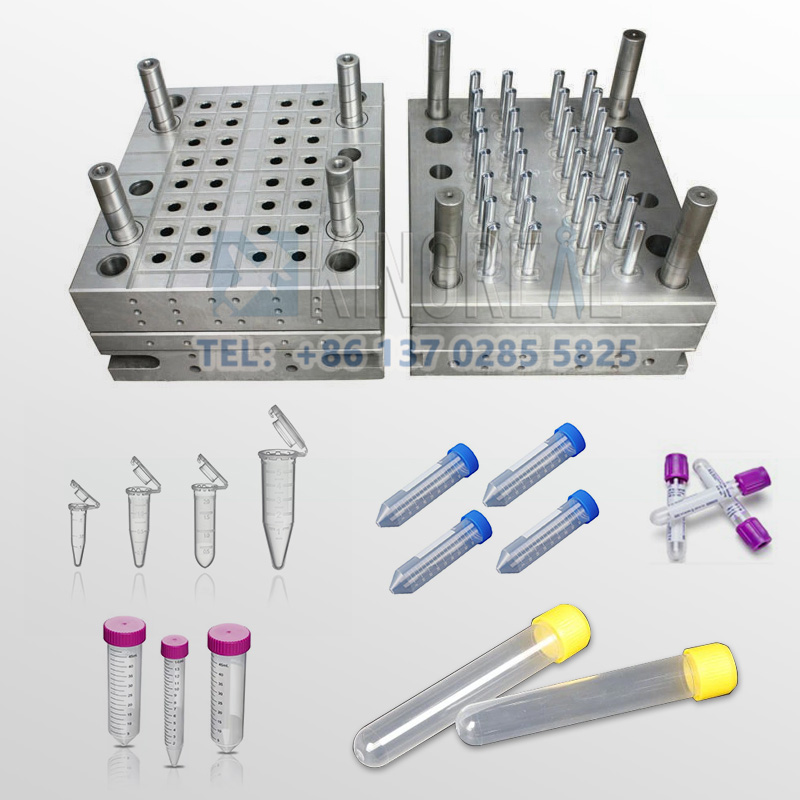

Professional Custom Laboratory Ware Injection Molds
Laboratory ware injection molds are designed for mass production and personalized processing of sterile, high-precision, and pollution-free laboratory plastic consumables. They ensure that finished consumables possess excellent chemical resistance, sterility, and zero-pollution properties, meeting the stringent production standards of life science and medical laboratories. Among the full range of professionally customized laboratory ware injection molds, centrifuge tube molds are in high demand and are frequently purchased by customers.
KRMOLD has deep expertise in plastic injection mold R&D and manufacturing, offering a wide variety of professionally customized laboratory ware injection molds in various styles and specifications. All laboratory ware injection molds are designed and manufactured one-to-one based on the customer's actual project parameters, product drawings, production capacity requirements, and usage scenarios, perfectly meeting the customer's personalized production needs.
If you are looking for a reliable supplier of laboratory ware injection molds, KRMOLD offers a one-stop solution, covering the entire closed-loop service from initial design, precision mold production, trial molding and commissioning, mass production optimization, to after-sales maintenance. Contact KRMOLD to obtain detailed parameters and customized solutions for your laboratory ware injection mold needs.
Why are Laboratory Ware Injection Molds Crucial in Healthcare Field?
I. Ensuring Safety and Cleanliness of Medical Laboratory Products
Medical laboratory equipment adheres to stringent cleanliness and bio-safety standards. Therefore, professionally customized laboratory ware injection molds must use medical-grade stainless steel such as S136, combined with a standardized, integrated anti-rust, anti-residue, and anti-contamination structural design. This process completely avoids problems such as mold corrosion, residual grease in the cavity, and impurities, eliminating the risk of cross-contamination of finished products and ensuring that the products produced by professionally customized laboratory ware injection molds have qualified bio-compatibility.
Furthermore, professionally customized laboratory ware injection molds can precisely control the high-temperature, high-pressure injection molding process of medical-grade PP, PC, and PS plastics, preventing degradation and deterioration of the polymeric medical raw materials. This ensures that glassware produced by these molds is completely safe and unreactive, with no impurities leaching, when in contact with human biological samples or testing reagents.
II. Efficient Scaled Production and Cost Control
High-quality laboratory ware injection molds can achieve a mold life of over 1 million cycles, enabling stable daily production of tens of thousands of consumables. This ensures high uniformity in size and performance of large batches of finished products, meeting the urgent and large-scale supply needs of disposable laboratory consumables in the medical industry.
Equipped with a multi-cavity mold structure and mature hot runner technology, these laboratory ware injection molds significantly reduce material waste and shorten the injection cooling cycle. Combined with automated part removal processes, this effectively reduces the production cost per consumable, helping companies enhance their market competitiveness.
Ready to Partner?
This high-precision, professionally customized laboratory ware injection mold is suitable for three core customer groups:
1
Medical Diagnostic Equipment OEM Manufacturers
Global healthcare companies with a complete industry chain, developing their own exclusive diagnostic reagent kits and consumable structures.
2
Contract Manufacturing Organizations (CMOs)
Contract manufacturing companies specializing in medical plastic parts processing and cleanroom aseptic injection molding.
3
Life Science Consumables Brand Owners
Brand companies that retail standardized disposable laboratory consumables to global research institutions, university laboratories, and commercial testing laboratories.