KRMOLD plastic chair injection molds can produce traditional and customized chair styles for a wide range of indoor and outdoor applications.
In the manufacturing process of plastic chair injection mould, KRMOLD pays close attention to the cycle time, parting line, wall thickness, and venting.
KRMOLD offers a diverse range of refrigerator parts injection mould capable of producing components such as drawers, egg trays, door liners, handles, door frames, and fridge lower vent frames, fully covering the molding needs for both interior and exterior plastic parts.
KRMOLD is dedicated to providing a complete range of plastic pallet injection molds, capable of producing pallets in various sizes for widespread use in everyday goods handling and product transportation in factories. KRMOLD plastic pallet injection mould not only meet market demands but also offer customized designs based on different customer application scenarios and handling conditions.
KRMOLD specializes in providing high-quality waste bin injection molds, capable of designing and manufacturing plastic trash bin injection molds for various capacities to meet specific project needs, including 32L, 45L, 60L, 80L, 120L, and 240L.
KRMODL can provide customers with a wide range of Logistic Packaging Injection Mold, according to the customer's product requirements for customized design of injection molds and the process of manufacturing injection molds, Logistic Packaging Injection Molds are used for the production of logistics and transportation required for the products. Logistic Packaging Injection Mold is a large-scale injection mold product.
KRMOLD is a professional injection mold manufacturer in China that can provide Food Packaging Injection Molds, which are designed to produce food packaging products with various specific shapes and functions. As an important injection molding tool, Food Packaging Injection Molds can produce food packaging products that meet food requirements. Welcome to contact us to get the latest design solutions
KRMOLD can provide customers with complete Thin-Wall Container Injection Molds solutions to manufacture injection molds that meet the production requirements of thin-walled products, such as disposable lunch box injection molds, electronic component packaging injection molds, and medical device injection molds.
KRMOLD thin wall container injection molds are characterized by high strength mold structure, precise process control and material innovation. Contact us for new injection molding solutions.
KRMOLD helps customers with complete injection mold design, production and after-sales services, and is able to provide customers with Cosmetic Container Injection Molds, which are used to produce molds for various cosmetic packaging containers. Injection molding technology is used to make plastic raw materials into specific shapes of packaging, such as bottles, jars, lids and so on.
Unlocking the Enigma of Plastic Fan Blade Injection Mould
2025-12-09
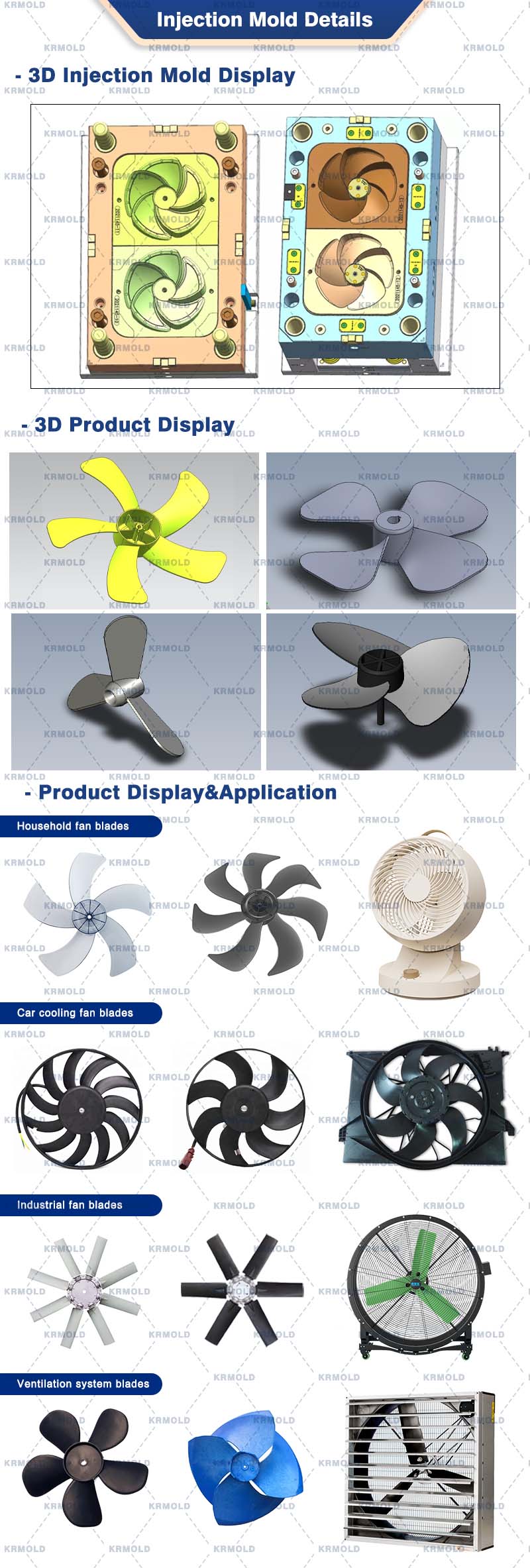
Plastic fan blade injection mould are specifically designed for manufacturing fan blades and primarily consist of two important parts: the cavity and the core. These two parts work together to shape the desired fan blade geometry. This article will delve into the structure, manufacturing process, material selection, and applications of plastic fan blade injection molds across various industries, helping readers better understand plastic fan blade injection mould.
1/Multiple Applications of Plastic Fan Blade Injection Mold
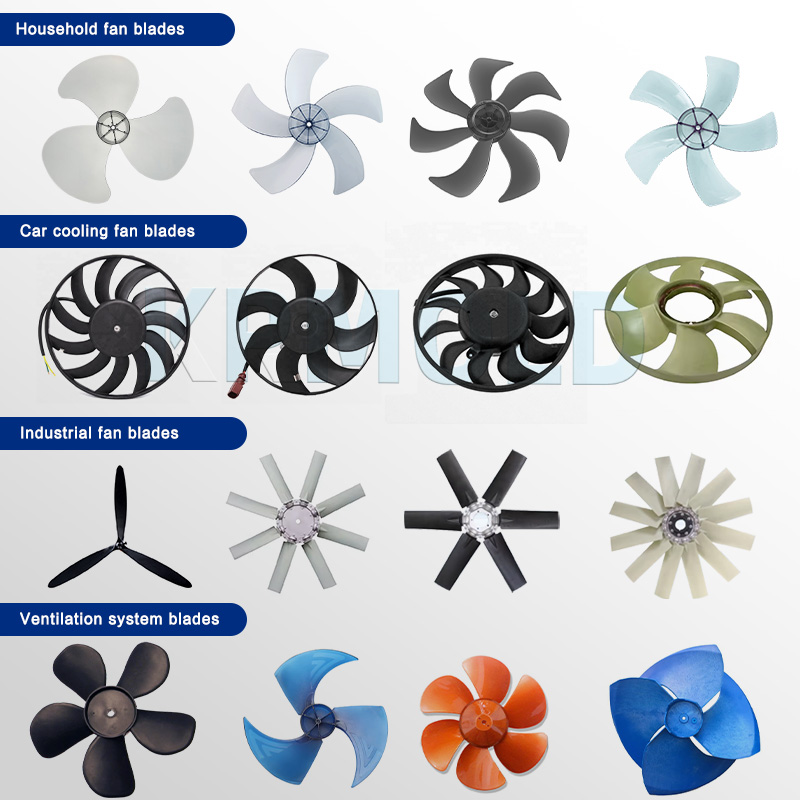
Various kinds of fan blades, including custom-shaped ones and typically available standard forms, can be produced using plastic fan blade injection mold. They can specifically be classified as follows:
1.1 Plastic fan blade injection mold for axial fan
Plastic fan blade injection mould are typically designed with multiple curved blades surrounding a central hub, specifically for producing axial fans. The airflow direction of this type of fan is parallel to the axis of rotation, effectively controlling wind speed and generating vortexes. In the cooling systems of some mechanical systems and medical equipment, axial fan molds, through clever design, can significantly improve cooling efficiency, enabling the design of powerful airflow devices, thereby saving energy and achieving efficient heat dissipation.
1.2 Plastic fan blade injection mold for centrifugal fan
Centrifugal fans may be made using plastic fan blade injection mould, which uses curved blade forms producing airflow perpendicular to the centrifugal centerline and hence raises airflow pressure. This form streamlines the rotation mechanism and raises general efficiency by giving centrifugal fan blades an aerodynamic form, so making them much used in several industrial and home applications.
1.3 Plastic fan blade injection mold for crossflow fan
Plastic fan blade injection mould can produce crossflow fans, also known as tangential fans. These fans generate airflow through narrow openings perpendicular to the axis of rotation. The blade design of crossflow fan molds is particularly critical, affecting the direction, speed, and pressure of the airflow. By adjusting the curvature and angle of the blades, the airflow organization and performance of the fan can be optimized, making the product more suitable for actual application environments.
2/Plastic Fan Blade Injection Mold Manufacturing Process
Wire EDM: Suitable for high-precision contour machining, capable of handling complex shapes.
Electrical Discharge Machining (EDM): Used to create complex cavities, ensuring perfect rendering of minute details.
Surface Grinding: Ensures the flatness of the mold core, allowing each contact surface to achieve optimal sealing.
CNC Milling: Used for roughing and semi-finishing, improving overall manufacturing efficiency.
2.2 Machining Accuracy and Surface Quality Control
The machining accuracy of the plastic fan blade injection mold directly affects the quality of the final plastic fan blades. Common quality control methods include:
●Using a CMM to inspect critical dimensions;
●Employing high-precision cutting tools and fixtures to ensure machining accuracy;
●Controlling the temperature and humidity of the machining environment to reduce errors caused by external factors;
●Performing surface polishing to achieve the required surface roughness (e.g., Ra ≤ 0.8 μm).
3/Applications of Plastic Fan Blade Injection Mould
3.1 Plastic fan blade injection mold for electronic equipment
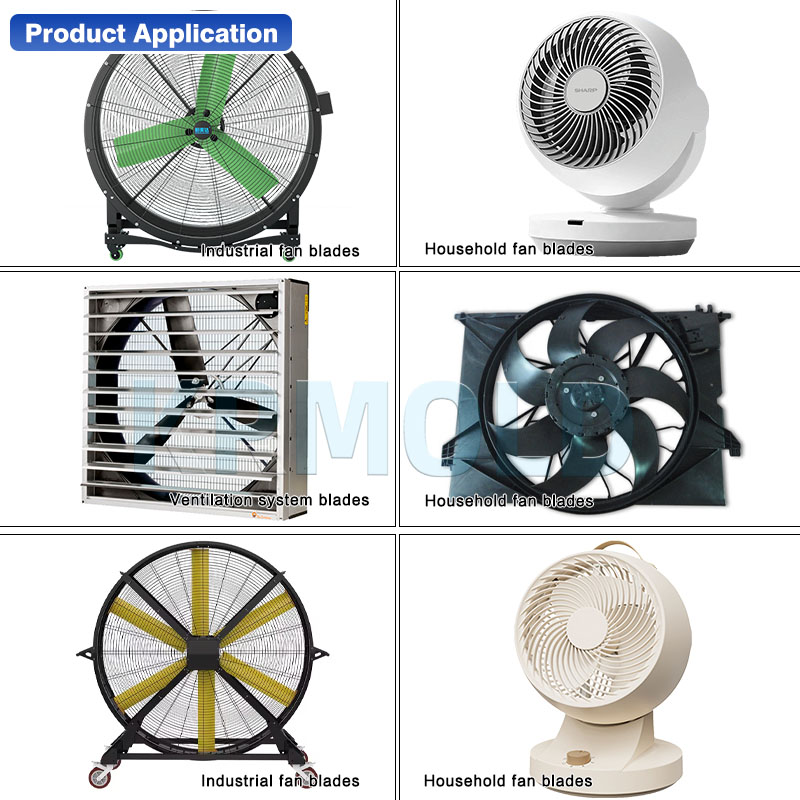
Fan blades are widely used in the heat dissipation systems of electronic devices such as computers and servers to ensure stable operation. Furthermore, excellent design can greatly improve heat exchange efficiency, providing better heat dissipation conditions for the equipment.
3.2 Plastic fan blade injection mould for air conditioning systems
In air conditioning systems, the design and manufacturing of fan blades directly affect indoor air circulation and cooling efficiency. Excellent plastic fan blades may greatly boost the general efficiency of air conditioning, therefore increasing environmental friendliness and energy efficiency.
3.3 Plastic fan blade injection mold for automotive industry
Widely utilized in automotive engine cooling systems, fan blades help to dissipate heat, boost engine efficiency, and guarantee consistent vehicle performance under different driving circumstances.
3.4 Plastic fan blade injection mould for industrial production
Ensuring a safe and effective working atmosphere, fan blades in industrial manufacture are employed for drying, dust removal, and ventilation. Keeping a nice manufacturing environment depends on these features.
4/Core Elements of Plastic Fan Blade Injection Mold Design
4.1 Material Selection
Polypropylene (PP): Excellent heat resistance, chemical resistance, and impact resistance, and is inexpensive.
Polyvinyl chloride (PVC): Highly corrosion-resistant, suitable for making pipes and flooring.
Polyethylene (PE): Flexible and chemically resistant, commonly used for making films and containers.
Polystyrene (PS): High transparency and good thermal insulation, suitable for disposable tableware and packaging boxes.
4.2 Material Performance Indicators
Mechanical Properties: Including tensile strength, flexural strength, and impact strength.
Physical Properties: Such as density, melting point, glass transition temperature, and water absorption.
Chemical Properties: Acid and alkali resistance, solvent resistance, and high-temperature resistance.
Electrical Properties: Insulation strength, dielectric constant, and resistivity.
These indicators will help engineers determine whether the material is suitable for a specific fan blade application, ensuring optimal fan blade performance.
4.3 Plastic Fan Blade Injection Mold Structure and Components
Standing Mold: Fixed to the injection molding machine, housing the core of the plastic fan blade injection mould and ensuring it works in conjunction with the moving mold to complete injection molding.
Moving Mold: A movable mold that works with the stationary mold to complete the injection molding process, connecting the gating system and nozzles.
Gating System: The channel that delivers molten plastic to the mold cavity, including the gate, runner, and nozzles.
Cooling System: Controls the plastic fan blade injection mold temperature through circulating cooling water to ensure rapid cooling and solidification of the plastic product for demolding.
4.4 Gating and Nozzle Design
Uniform filling of the plastic fan blade injection mould with molten plastic depends on a suitable gating design. During construction, the gate should be set at the thinnest section of the fan blade or close to the center. Smooth plastic flow depends also on the shape of the nozzle matching that of the gate.
4.5 Cooling System Design
Directly influencing the molding time and quality of the plastic fan blades is the cooling system's design. Rapid plastic cooling and curing depend on enough cooling water circulation and even distribution of cooling water pathways. Moreover, periodic care of the cooling system to guarantee free water flow is essential for prolonging its life span.
4.6 Core-pulling and Ejection Mechanisms
The core-pulling mechanism guarantees the blades are taken whole from the plastic fan blade injection mold, but the ejection system aids in pushing the molded fan blades out to avoid adhesion. Both must collaborate to guarantee easy demolding.