KRMOLD plastic chair injection molds can produce traditional and customized chair styles for a wide range of indoor and outdoor applications.
In the manufacturing process of plastic chair injection mould, KRMOLD pays close attention to the cycle time, parting line, wall thickness, and venting.
KRMOLD offers a diverse range of refrigerator parts injection mould capable of producing components such as drawers, egg trays, door liners, handles, door frames, and fridge lower vent frames, fully covering the molding needs for both interior and exterior plastic parts.
KRMOLD is dedicated to providing a complete range of plastic pallet injection molds, capable of producing pallets in various sizes for widespread use in everyday goods handling and product transportation in factories. KRMOLD plastic pallet injection mould not only meet market demands but also offer customized designs based on different customer application scenarios and handling conditions.
KRMOLD specializes in providing high-quality waste bin injection molds, capable of designing and manufacturing plastic trash bin injection molds for various capacities to meet specific project needs, including 32L, 45L, 60L, 80L, 120L, and 240L.
KRMODL can provide customers with a wide range of Logistic Packaging Injection Mold, according to the customer's product requirements for customized design of injection molds and the process of manufacturing injection molds, Logistic Packaging Injection Molds are used for the production of logistics and transportation required for the products. Logistic Packaging Injection Mold is a large-scale injection mold product.
KRMOLD is a professional injection mold manufacturer in China that can provide Food Packaging Injection Molds, which are designed to produce food packaging products with various specific shapes and functions. As an important injection molding tool, Food Packaging Injection Molds can produce food packaging products that meet food requirements. Welcome to contact us to get the latest design solutions
KRMOLD can provide customers with complete Thin-Wall Container Injection Molds solutions to manufacture injection molds that meet the production requirements of thin-walled products, such as disposable lunch box injection molds, electronic component packaging injection molds, and medical device injection molds.
KRMOLD thin wall container injection molds are characterized by high strength mold structure, precise process control and material innovation. Contact us for new injection molding solutions.
KRMOLD helps customers with complete injection mold design, production and after-sales services, and is able to provide customers with Cosmetic Container Injection Molds, which are used to produce molds for various cosmetic packaging containers. Injection molding technology is used to make plastic raw materials into specific shapes of packaging, such as bottles, jars, lids and so on.
Design Analysis of Auto Headlight Holder Plastic Mold
2026-04-21
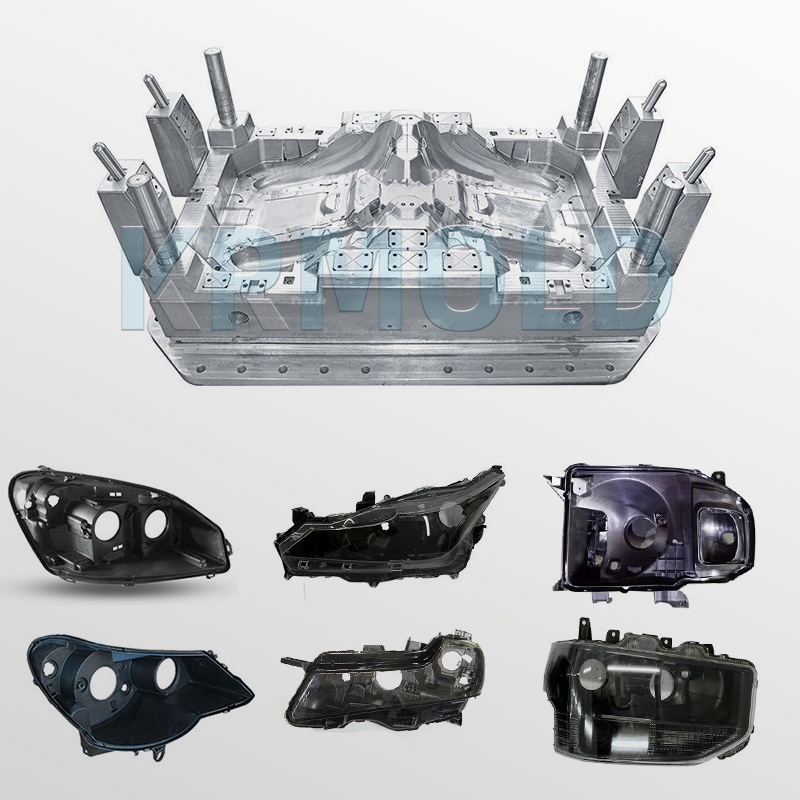
Auto headlight holder plastic molds are utilized for the mass production of these components, which constitute one of the critical elements in the automotive manufacturing and assembly process. The rationality of the auto headlight holder injection mold's design and the stability of its structure directly determine the production efficiency, dimensional precision, and service life of the auto headlight holders; consequently, these factors impact the overall assembly quality and lighting safety of the vehicle's headlights.
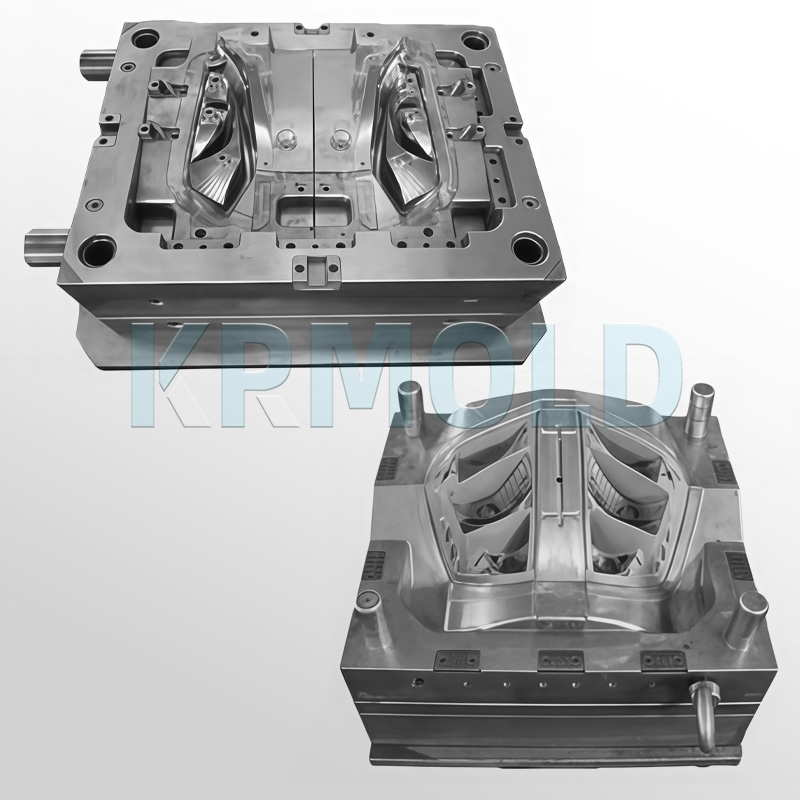
In this article, KRMOLD presents a case based on an actual design project for an auto headlight holder injection mold. By integrating industry technical specifications with material characteristics, we provide a detailed overview of the key design considerations, structural analysis, and workflow involved in creating such auto headlight holder plastic molds, thereby offering a valuable reference for the design and production of similar tooling.
Technical Background of Auto Headlight Holder Plastic Mold
With the continuous advancement of the automotive industry, light-guide auto headlight holders are being increasingly incorporated into automotive headlights to facilitate both signaling and illumination functions. This trend has, in turn, imposed more stringent requirements on the molding quality of the auto headlight holders themselves. The production of these automotive headlight light-guide holders is inextricably linked to the use of plastic molds; specifically, the injection molding process—distinguished by its advantages in efficiency, mass production capability, and high precision—has emerged as the dominant method for manufacturing automotive headlight holders. By utilizing advanced auto headlight holder injection molds, manufacturers can significantly enhance both the production efficiency and quality of light-guide components, reduce manufacturing costs, and simultaneously meet the automotive industry's evolving demands for lightweight, integrated, and high-precision parts.
In the current climate of intensifying competition within the automotive sector—where automakers are constantly raising their standards for component production efficiency and quality—the design and optimization of auto headlight holder plastic molds have become a pivotal factor in enhancing product competitiveness.
Auto Headlight Holder Injection Mold Design Analysis
The design of an auto headlight holder plastic mold directly dictates the molding quality of the plastic part as well as the overall production efficiency. A complete auto headlight holder injection mold typically comprises several core subsystems: a side-core pulling mechanism, a gating system, a temperature control system, a guiding and positioning mechanism, and an ejection mechanism.
During the design phase, it is essential to carefully consider the specific structural characteristics of the plastic part; based on these features, each component of the auto headlight holder plastic mold must be designed in a rational and balanced manner, prioritizing practicality, structural stability, and economic viability.
1. Analysis of Plastic Part Structure
To enhance the strength and rigidity of the plastic part—thereby meeting the vibration and impact requirements encountered during vehicle operation—reinforcing ribs are typically incorporated into critical areas during the design phase. This approach not only ensures the structural stability of the part but also prevents defects such as shrinkage deformation and warping during the molding process. Since the auto headlight holder requires precise assembly with other headlight components, its plastic structure is inherently complex and features numerous undercut structures. While these undercuts are crucial for the part's functional performance, they present significant challenges for the design of the corresponding auto headlight holder injection mold.
To facilitate the smooth ejection of the molded part, a substantial number of lateral core-pulling mechanisms are required. However, the simultaneous movement of multiple lateral core-pulling mechanisms creates a risk of mutual interference; furthermore, the large surface area of the molded part further compounds the design complexity of the auto headlight holder plastic mold and imposes stringent requirements on the coordinated operation of the various mold mechanisms.
2. Analysis of Auto Headlight Holder Plastic Mold Structure
During the design process for this auto headlight holder injection mold, the KRMOLD team began by conducting an in-depth analysis of the part's molding orientation and the overall mold layout. If the concave side of the plastic part were to be formed by the moving mold, the angled guide pins would be positioned on the moving mold side, while the sliders would be located on the fixed mold side. Such a layout would create logistical difficulties regarding the arrangement of cooling channels and ejection mechanisms, thereby compromising the overall structural integrity and operational stability of the auto headlight holder plastic mold.
Following rigorous analysis and repeated technical validation, the KRMOLD team decided to configure the auto headlight holder injection mold so that the concave side of the plastic part is formed by the fixed mold. Although this layout optimizes the arrangement of cooling channels and ejection mechanisms, the cooling shrinkage of the molten plastic generates significant clamping force against the fixed mold. This phenomenon often leads to difficulties in demolding—potentially even resulting in damage to the plastic part. While the adoption of an inverted mold structure could theoretically resolve these demolding challenges, it would simultaneously increase the structural complexity of the auto headlight holder plastic mold, escalate manufacturing difficulties and production costs, and ultimately diminish the operational reliability of the mold system.
Consequently, by carefully balancing the specific structural characteristics of the plastic part with the practical requirements of production, KRMOLD engineers opted to implement a combination of a dual-stage demolding mechanism and a delayed core-pulling mechanism. Through the synergistic action of these mechanisms, the plastic part is effectively compelled to remain on the moving mold side, thereby providing a robust and effective solution to the problem of difficult demolding. Furthermore, taking into account factors such as safe and reliable operation, structural simplicity, and ease of machining and maintenance for the auto headlight holder injection mold, this design adopts a two-plate mold structure. This approach simplifies the auto headlight holder plastic mold structure and reduces machining complexity while simultaneously ensuring the auto headlight holder injection mold's operational stability and production efficiency.
3. Design of Molded Components
In this design for the auto headlight holder plastic mold, both the moving mold and the fixed mold utilize a monolithic structure. This monolithic structure offers advantages such as structural stability, high rigidity, and superior molding precision, effectively preventing deformation during the molding process and ensuring the dimensional accuracy of the plastic part.
On the fixed mold side, the pillar sections of the plastic part are formed using insert pins. This design not only facilitates the replacement and maintenance of the inserts—allowing for the individual replacement of a worn or damaged insert without the need to replace the entire fixed mold, thereby reducing maintenance costs—but also promotes smoother venting within the auto headlight holder injection mold. This effectively prevents molding defects such as air bubbles and sink marks in the plastic part. All holes in the plastic part are formed using inserts, with mating faces established between adjacent inserts. To ensure the reliable operation of the auto headlight holder plastic mold and prevent insert misalignment from compromising the precision of the plastic part, the mating faces of the inserts are machined into tapered surfaces. This achieves precise positioning, thereby guaranteeing the accuracy and stability of the insert assembly.
Operation Process of Auto Headlight Holder Injection Mold
1
Filling Phase
The plastic raw material is heated and melted within the injection molding machine's barrel to form a uniform plastic melt. Subsequently, driven by the high pressure of the injection molding machine, the melt flows through the machine nozzle, the hot runner (3), and the hot nozzle (4) into the cavity of the auto headlight holder plastic mold, continuing until the melt completely fills the entire cavity, thereby completing the filling process. During this phase, strict control over injection pressure, injection speed, and melt temperature is essential to ensure that the melt fills the cavity uniformly and rapidly, preventing defects such as short shots (incomplete filling) and flow marks.
2
Holding and Cooling Phase
Once the melt has filled the cavity, the injection molding machine's screw continues to apply pressure to compensate for the volume shrinkage that occurs as the plastic melt cools. This ensures the dimensional accuracy and density of the plastic part, preventing defects such as sink marks and surface depressions. Concurrently, the temperature control system within the auto headlight holder injection mold facilitates uniform cooling of the mold cavity. This process allows the molten plastic within the cavity to gradually cool and solidify, thereby forming an auto headlight holder component that meets all specified requirements. Precise control of the cooling time is critical; insufficient cooling can lead to deformation of the plastic part after demolding, while excessive cooling results in reduced production efficiency.
3
Mold Opening Phase
Once the plastic part has cooled and solidified to the point where it is ready for demolding, the injection molding machine applies force to separate the moving half from the fixed half of the auto headlight holder injection mold—a process known as mold opening. During this opening sequence, the inserts within the fixed mold half are ejected via spring action. Due to a delayed core-pulling design incorporated into the sliders, the sliders remain stationary at this stage; this causes them to pull the plastic part toward the moving mold side, thereby ensuring a smooth separation of the part from the fixed mold half. Once the auto headlight holder plastic mold has opened to a specific extent, the sliders initiate their core-pulling action, gradually disengaging from the undercut features on the plastic part and ultimately ensuring that the part remains entirely on the moving mold side.
4
Demolding, Reset, and Mold Closing Phases
Upon completion of the auto headlight holder injection mold opening and core-pulling operations, the process enters the demolding phase. First, the ejector rod of the injection molding machine advances to push the ejector plate and retainer plate assembly. This assembly, in turn, drives the ejector sleeves and pins forward, smoothly pushing the plastic part—which remains on the moving mold side—out of the auto headlight holder plastic mold to complete the demolding process. Subsequently, under the force of springs, the ejector components and their retainer plates return to their original positions, preparing the auto headlight holder injection mold for the next injection cycle. Finally, the injection molding machine drives the moving mold half back toward the fixed mold half to achieve mold closure; the auto headlight holder plastic mold thus returns to its initial state, ready to enter the next stage of injection molding production and complete the operational cycle.
The KRMOLD team has designed a highly reliable auto headlight holder injection mold —a component characterized by its complex structure and stringent precision requirements. The design prioritizes structural simplicity wherever possible to facilitate ease of processing and manufacturing, thereby shortening production cycles and enhancing production efficiency, while simultaneously ensuring a high degree of production automation.