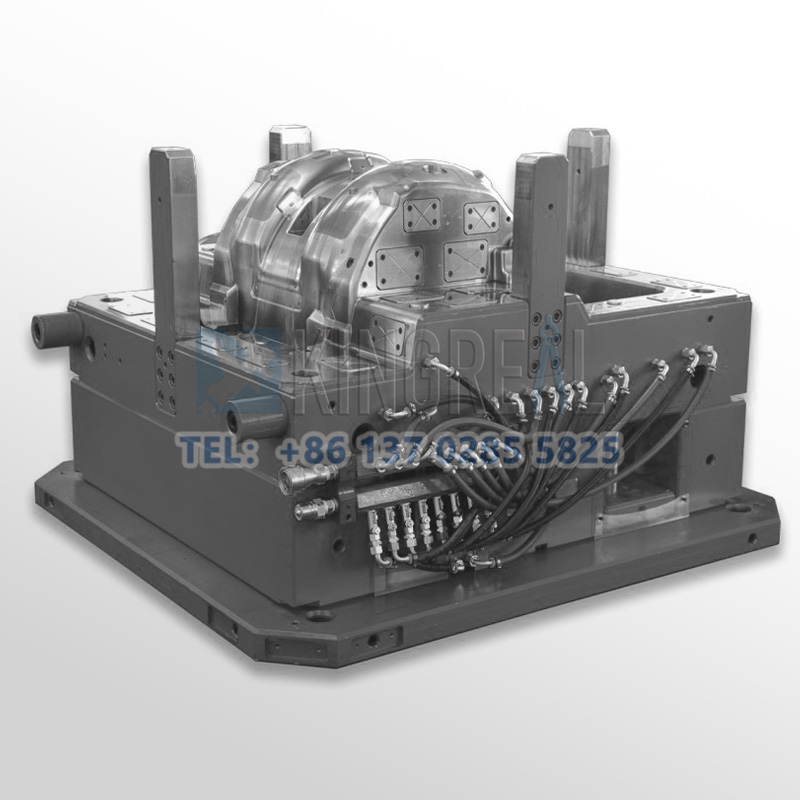
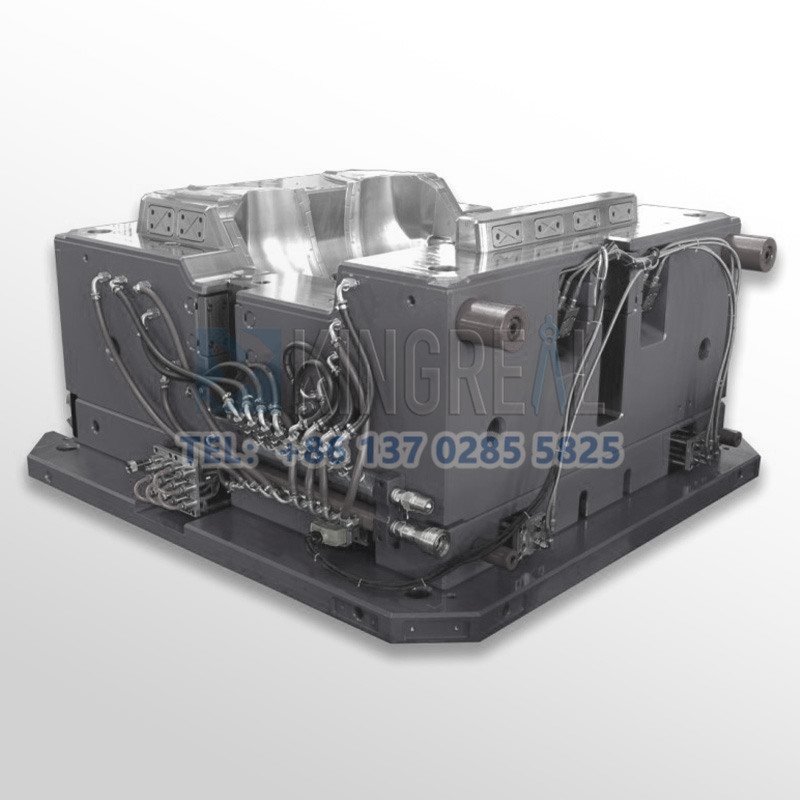
KRMOLD plastic chair injection molds can produce traditional and customized chair styles for a wide range of indoor and outdoor applications.
In the manufacturing process of plastic chair injection mould, KRMOLD pays close attention to the cycle time, parting line, wall thickness, and venting.
KRMOLD offers a diverse range of refrigerator parts injection mould capable of producing components such as drawers, egg trays, door liners, handles, door frames, and fridge lower vent frames, fully covering the molding needs for both interior and exterior plastic parts.
KRMOLD is dedicated to providing a complete range of plastic pallet injection molds, capable of producing pallets in various sizes for widespread use in everyday goods handling and product transportation in factories. KRMOLD plastic pallet injection mould not only meet market demands but also offer customized designs based on different customer application scenarios and handling conditions.
KRMOLD specializes in providing high-quality waste bin injection molds, capable of designing and manufacturing plastic trash bin injection molds for various capacities to meet specific project needs, including 32L, 45L, 60L, 80L, 120L, and 240L.
KRMODL can provide customers with a wide range of Logistic Packaging Injection Mold, according to the customer's product requirements for customized design of injection molds and the process of manufacturing injection molds, Logistic Packaging Injection Molds are used for the production of logistics and transportation required for the products. Logistic Packaging Injection Mold is a large-scale injection mold product.
KRMOLD is a professional injection mold manufacturer in China that can provide Food Packaging Injection Molds, which are designed to produce food packaging products with various specific shapes and functions. As an important injection molding tool, Food Packaging Injection Molds can produce food packaging products that meet food requirements. Welcome to contact us to get the latest design solutions
KRMOLD can provide customers with complete Thin-Wall Container Injection Molds solutions to manufacture injection molds that meet the production requirements of thin-walled products, such as disposable lunch box injection molds, electronic component packaging injection molds, and medical device injection molds.
KRMOLD thin wall container injection molds are characterized by high strength mold structure, precise process control and material innovation. Contact us for new injection molding solutions.
KRMOLD helps customers with complete injection mold design, production and after-sales services, and is able to provide customers with Cosmetic Container Injection Molds, which are used to produce molds for various cosmetic packaging containers. Injection molding technology is used to make plastic raw materials into specific shapes of packaging, such as bottles, jars, lids and so on.
Comprehensive Guide to Automobile Fender Injection Mold
2026-04-01
Automobile fender injection molds are specifically designed for the mass production of car fenders. Critical exterior body panels, fenders have a basic purpose: protecting underbody parts and preventing mud and gravel from striking the vehicle body. Moreover, they have a straight impact on the general aerodynamic design and artistic flair of the vehicle. Therefore, automobile fender injection molds call for far more stringent demands on geometrical precision, surface quality, and material performance than typical plastic injection molds. A good car fender injection mold raises production efficiency and lowers manufacturing expenses in addition to guaranteeing the consistency and high acceptance rate of the molded fenders. This piece gives a thorough introduction to automobile fender injection molds, enabling you to better grasp this sophisticated tool. We encourage you to get in touch with KRMOLD for a consultation if you're wanting to buy superior car fender injection molds.
Key Design Considerations for Car Fender Injection Molds
1. Geometry and Dimensional Control
An automobile fender injection mold's cavity design must precisely fit its assembly datum points and functional requirements by strictly following the product design drawings. Too much dimensional variance would cause uneven assembly gaps and poor sealing, therefore reducing both the visual attractiveness of the car and its ability to repel dust and debris since the fender must smoothly match with nearby elements—like the quarter panels and bumpers of the vehicle. It is imperative during the design phase to fully consider possible problems with shrinkage, distortion, and warping of the molten plastic during injection molding. Appropriate draft angles, usually ranging from 1° to 3°, must be set depending on the fender's material (usually thermoplastics like PP or TPO) to avoid scratching or damage of the fender component throughout demolding. Simultaneously, the chamfers and fillets within the mold cavity should be optimized; this serves the dual purpose of preventing stress concentration (which could lead to cracks in the molded fender) and facilitating smooth melt flow and easy demolding. Moreover, a correct alignment between the moving and fixed halves of the automobile fender injection mold must be guaranteed by a precise positioning system. This prevents defects such as automobile fender injection mold misalignment and flash, thereby guaranteeing dimensional consistency in the fender products and ensuring compliance with the ISO 2768-mK dimensional tolerance standards specified in the latest edition of the General Technical Conditions for Automotive Stamping Dies.
2. Gating System and Venting
The gating system directly influences the flow behavior of the molten material and the molding quality of the fender products. During the design phase, priority must be placed on selecting appropriate gate types and locations. Based on the specific size and geometry of the fender, side gates or pin-point gates are generally preferred to ensure uniform filling of the mold cavity, thereby preventing issues such as uneven flow and prominent weld lines. Concurrently, the car fender injection mold requires a well-planned venting system. Air can readily get trapped in the mold cavity during the injection process given the high volume and intricate geometry of fenders. Poor ventilation causes flaws like air voids, cold shut, burns, and surface sink marks in the completed product, therefore damaging its structural integrity and visual appeal. Usually found at the corners of the mold cavity and at the termination of the melt flow path are venting channels. To guarantee the steady expulsion of air while also preventing the molten material from overflowing, one commonly uses a multi-stage venting system. Moreover, combining vacuum-assisted injection molding techniques can help to improve venting effectiveness and greatly lower the error rate.
3. Cooling and Temperature Control
While simultaneously guaranteeing the dimensional stability and surface flatness of the fender items, a well-designed cooling system helps to shorten molding cycle times and maximize production efficiency. Uniform cooling channel designs and fast heat transfer techniques should be given first consideration in design projects. Based on the particular fender geometry, cooling water channels should be evenly spaced throughout the mold cavity to guarantee consistent temperature across every part. This avoids faults—such as warping, distortion, and sink marks—that might result from local cooling rates being either too high or too low. The cooling water's temperature difference should be kept within a tight limit of 3°C. While heat pipes ought to be employed in thick-walled sections to improve heat exchange efficiency, thin-walled sections call for turbulent flow cooling. Furthermore improving the general molding quality of the fender items, the car fender injection mold may be fitted with a temperature control system able of real-time monitoring and modification. This guarantees constant temperature throughout the injection molding procedure.
4. Car Fender Injection Mold Strength and Lifespan
During the long-term mass production of automobile fender injection molds, the car fender injection molds are subjected to high temperatures, high pressures, and the erosive scouring of molten plastic. Consequently, the strength and lifespan of the automobile fender injection mold are of paramount importance. During the design phase, appropriate mold steel must be selected; commonly used options include pre-hardened mold steels such as P20 and 718H. To guarantee the automobile fender injection mold has adequate strength, rigidity, and wear resistance, premium choices such NAK80 mirror-finish mold steel or S136 stainless steel can be selected for car fender injection molds meant for high-end vehicle models. Concurrently, the car fender injection mold has to be properly heat treated and surface treated—such as nitriding or chrome plating. Chrome plating improves the surface smoothness and corrosion resistance of the automobile fender injection mold, thereby reducing molten material adhesion and lengthening the vehicle's general service life. Nitrogen treatment raises both its surface hardness and wear resistance.
Automobile Fender Injection Mold Processing and Manufacturing Processes
1. CNC Machining
CNC machining is primarily utilized to execute high-precision roughing and finishing operations on key car fender injection mold components, including the mold cavity, guide structures, and gating systems. Using CNC machine tools' high-precision positioning and automated processing features, sophisticated cavity surfaces can be cut with amazing precision. Within ±0.02 mm, processing tolerances can be managed, therefore guaranteeing that the geometry and dimensions of the mold cavity precisely matched the design requirements. While the finishing phase emphasizes guaranteeing the flatness and dimensional correctness of the cavity surface and so establishing a strong basis for following surface treatments, the roughing stage emphasizes removing superfluous material to maximize processing efficiency.
2. EDM
EDM technology enables the precise machining of complex surfaces, deep cavities, and intricate details—such as snap-fit features and positioning holes—within the cavities of automobile fender injection molds. EDM operates by generating electrical sparks between an electrode and the mold steel, which gradually erodes the steel to form the desired cavity shape and details. This process offers the distinct advantages of high machining precision and the ability to fabricate complex structures; it allows for the precise reproduction of the minute structural features required for the fender product, thereby ensuring the integrity of the mold cavity details and fulfilling the assembly and functional requirements of the automotive fender.
3. Surface Polishing and Treatment
The cavity surfaces of car fender injection molds require rigorous surface polishing and treatment to ensure a high degree of surface finish. This process minimizes scratches and burrs on the finished fender products, thereby reducing the workload associated with secondary processing. During the polishing process, a progressively finer technique must be employed—ranging from coarse to fine polishing—based on the specific characteristics of the mold steel. The aim is to attain a cavity surface roughness of Ra less than or equal to 0.8 μm. For car fender injection molds meant for luxury car models, the cavity surfaces normally need polishing to a mirror finish to guarantee the ultimate fender products are smooth and faultless, therefore improving the general aesthetic quality of the vehicle.
4. Assembly and Car Fender Injection Mold Trial
Strict adherence to design requirements is required during the automobile fender injection mold manufacturing process. To guarantee seamless component interaction and consistent mold-closing clearance, components like the moving mold half, fixed mold half, guide mechanisms, gating system, and cooling system must be precisely assembled. To mimic mass-production settings, plastic raw materials and injection parameters equal to those employed in real manufacturing must be chosen during the car fender injection mold test. The fender product molding results are then noted along with important variables like injection pressure, temperature, and molding time; the items are also inspected for dimensional variations, deformati, or other flaws. The car fender injection mold is modified and optimized according the results of the car fender injection mold test. A comprehensive automobile fender injection mold trial report is subsequently generated to provide accurate parameter benchmarks for subsequent mass production, ensuring that the car fender injection mold can consistently produce qualified fender products once it is put into active service.
How to Ensure Consistency Between Car Fender Injection Mold and Product Design?
-Clarify Design Requirements: Before designing and manufacturing an automobile fender injection mold, it is essential to fully understand the product's design requirements—including dimensional tolerances, geometric specifications, and performance standards. These requirements should be explicitly detailed in the product design documentation, serving as the foundational basis for the car fender injection mold's design and manufacture.
-Utilize High-Precision Design Tools: Employing advanced CAD software for mold design can significantly enhance both precision and efficiency. CAD software enables the precise simulation of the product's geometric shape and dimensions, thereby providing accurate data support for the automobile fender injection mold design process.
-Select High-Quality Materials and Processes: The selection of appropriate mold materials is paramount to ensuring the dimensional consistency and geometric accuracy of the final product. Materials possessing sufficient strength and rigidity should be selected to ensure that the car fender injection mold does not deform or experience excessive stress during the injection molding process. Furthermore, the adoption of precision machining techniques—such as CNC machining and precision grinding—can enhance the automobile fender injection mold's machining accuracy and surface quality.
-Rigorous Quality Control: A strict quality control system must be established throughout the car fender injection mold manufacturing process to monitor and inspect every stage. This includes raw material inspection, production process monitoring, and finished product sampling, all aimed at ensuring that the automobile fender injection mold's quality and performance meet the specified design requirements.
-Regular Maintenance and Calibration: Car fender injection molds may experience wear or deformation during use, which can compromise their accuracy and consistency. Therefore, regular maintenance and calibration are essential to ensure the molds remain in optimal working condition.
-Leveraging Advanced Technologies: With the continuous advancement of technology, cutting-edge techniques—such as 3D printing and smart manufacturing—can now be applied to the field of automobile fender injection mold design and manufacturing. These technologies serve to enhance car fender injection mold design precision and manufacturing efficiency, thereby further reducing production costs and improving product quality.